
If you would spend ₹50,000 a month in today's money once you move back, and you retire at 55 to 60, you need roughly ₹5.8 to 6.8 crore on the day you retire. That sounds like a lot, but in today's rupees it is about ₹1.6 to 1.8 crore. The gap between those two figures is 20 to 25 years of 6% inflation.
This guide shows where those numbers come from, how they change if you spend ₹30,000 or ₹1 lakh a month, what they mean in dollars, and the money moves that only NRIs have to plan for. To run your own numbers with your savings abroad and in India, use the Return to India planner.
The figures here are illustrative, not a forecast. They assume you are 35 today, your expenses are stated in today's rupees, inflation is 6% a year, your money earns 7% a year after you retire, it has to last until age 90, and you withdraw each year's spending at the start of that year. Living in India and still working? FinPlann has a separate guide for resident Indians.
How much money do you need to retire in India? The table
Start with what you will actually spend in India each month, in today's rupees. Not your current costs abroad, and not the "India is cheap" feeling from a two-week holiday at your parents' place. Then find your row and your retirement age.
| Monthly spend in today's ₹ | Retire at | Spending in the first retired year | Corpus needed at retirement | Same corpus in today's ₹ |
|---|---|---|---|---|
| ₹30,000 | 50 | ₹8.6 lakh | ₹2.9 crore | ₹1.2 crore |
| ₹30,000 | 55 | ₹11.6 lakh | ₹3.5 crore | ₹1.1 crore |
| ₹30,000 | 60 | ₹15.5 lakh | ₹4.1 crore | ₹0.95 crore |
| ₹50,000 | 50 | ₹14.4 lakh | ₹4.8 crore | ₹2.0 crore |
| ₹50,000 | 55 | ₹19.2 lakh | ₹5.8 crore | ₹1.8 crore |
| ₹50,000 | 60 | ₹25.8 lakh | ₹6.8 crore | ₹1.6 crore |
| ₹1,00,000 | 50 | ₹28.8 lakh | ₹9.6 crore | ₹4.0 crore |
| ₹1,00,000 | 55 | ₹38.5 lakh | ₹11.5 crore | ₹3.6 crore |
| ₹1,00,000 | 60 | ₹51.5 lakh | ₹13.5 crore | ₹3.2 crore |
Illustrative. Assumes age 35 today, 6% inflation, 7% return after retirement, money lasting to 90, withdrawals at the start of each year.
"In today's money" means the corpus divided back by inflation, so you can compare it with prices you know. ₹6.8 crore in 25 years buys roughly what ₹1.6 crore buys now. Both numbers are the same target. The first is the one your account balance has to show when you move.
Two things stand out. Retiring earlier needs a smaller corpus on the day, because prices have had less time to rise, but a bigger one in today's money, because it has to last 40 years instead of 30. And the ₹50,000 row at 60 means a first-year budget of about ₹2.15 lakh a month. That is not a lifestyle upgrade. It is today's ₹50,000 after 25 years of 6% inflation.
Step 1: Estimate your India expenses in rupees
This is the number that moves the result most, so be honest about the life you want. A family in a metro such as Bengaluru, Pune or Hyderabad that rents, travels and pays for a car and help will spend far more than a couple in their own flat in a tier-2 city. Build it up line by line:
- Housing: rent, or maintenance and property tax if you own
- Food, utilities, domestic help, transport
- Health insurance premiums and out-of-pocket medical costs, which rise fastest with age
- Travel, including flights back to wherever your children settle
- Dining out, hobbies, gifts, and the occasional phone or car upgrade
For context, ₹50,000 a month is about $521 at today's rate of roughly ₹96 per dollar. Many NRIs anchor on that dollar figure, find it small, and pick the ₹30,000 row. Price your actual India life in rupees instead.
Step 2: Inflate to your move-back year
Your expenses in the year you retire are today's figure grown at inflation. At 6% a year, ₹50,000 a month today becomes about ₹1.6 lakh a month by 55 and ₹2.15 lakh a month by 60, for a 35-year-old. Prices roughly triple in 20 years at 6% and more than quadruple in 25, so skipping this step leaves you with a target three to four times too small.
6% is an assumption, not a promise. Actual inflation has run both above and below it, and healthcare costs tend to rise faster than the average. The sensitivity table further down shows what one percentage point either way does.
Step 3: Size the corpus so it lasts to 90
The corpus needed is the amount that, invested at 7% a year, pays your inflation-rising expenses every year until you turn 90. The table above does exactly that, year by year. FinPlann's retirement corpus calculator lets you change every input, and the FIRE calculator is the better fit if you want to stop working in your 40s.
Why the 25x rule (4%) is optimistic for India
The 25x rule says you need 25 times your first year's expenses, which is the same as withdrawing 4% in year one. It comes from US research in the 1990s on US stock and bond returns over 30-year retirements. It is a useful starting point. It is not built for Indian inflation.
What matters is the gap between what your money earns and how fast your costs rise. At 7% returns and 6% inflation, your money earns only about 1% a year above inflation, so the corpus has to do more of the work itself. Under these assumptions the multiple you need is:
| Retire at | Years the money must last | Multiple of first-year expenses | First-year withdrawal rate |
|---|---|---|---|
| 50 | 40 | 33.5x | 3.0% |
| 55 | 35 | 30x | 3.3% |
| 60 | 30 | 26.3x | 3.8% |
So in India the multiple is closer to 26 to 34 times your first-year spending. For ₹50,000 a month at 60, the 25x rule gives ₹6.4 crore against ₹6.8 crore needed, a small gap. Retire at 50 and the 25x rule says ₹3.6 crore while you actually need ₹4.8 crore, a shortfall of about ₹1.2 crore.
What if inflation or returns are different?
Small changes in the assumptions move the answer a lot. Here is the ₹50,000-a-month, retire-at-60 case under different inflation and return rates:
| Inflation | Return after retirement | Corpus needed at 60 | Multiple of first-year expenses |
|---|---|---|---|
| 5% | 7% | ₹4.7 crore | 23.1x |
| 6% | 7% | ₹6.8 crore | 26.3x |
| 7% | 7% | ₹9.8 crore | 30x |
| 6% | 8% | ₹6.0 crore | 23.2x |
| 6% | 6% | ₹7.7 crore | 30x |
Illustrative. Same assumptions as the main table except the rate changed in each row.
One extra point of inflation adds about ₹3 crore. One point less return adds about ₹1 crore. Inflation hurts twice: it raises your first-year spending and every year after. If you want a margin of safety, plan around a higher inflation figure rather than a lower return.
How much is that in dollars?
Most NRIs save in dollars, dirhams or pounds, so the rupee target needs translating. At today's rate of about ₹96 per dollar (ECB reference rate, 28 September 2026), the ₹1 lakh-a-month targets look like this:
| Retire at | Corpus needed | In dollars at ₹96/$ | In dollars if the rupee weakens 3% a year until then |
|---|---|---|---|
| 50 | ₹9.6 crore | $1.0 million | $0.64 million |
| 55 | ₹11.5 crore | $1.2 million | $0.67 million |
| 60 | ₹13.5 crore | $1.4 million | $0.67 million |
Illustrative. Dollar figures are what you would need to hold at the time you move. At 3% a year the rupee would be about ₹150 per dollar by the time you are 50 and about ₹201 by 60.
For the ₹50,000-a-month family, the targets of ₹5.8 crore (at 55) and ₹6.8 crore (at 60) are $0.60 million and $0.70 million at today's rate, or $0.33 to 0.34 million if the rupee weakens 3% a year.
Here is how the currency effect works. Your corpus target is in rupees, because your costs in India are in rupees. If the rupee is weaker when you convert, each dollar buys more rupees, so fewer dollars are needed to reach the same rupee corpus. Over the last 20 years the rupee has weakened about 3.7% a year against the dollar on average (₹45.86 in September 2006 to ₹95.97 in September 2026, ECB reference rates).
Three cautions before you count on that:
- It only helps money still held in dollars. Savings you have already moved into rupees get no benefit, and Indian deposits earning less than inflation lose ground.
- The trend is not guaranteed. The rupee has had flat stretches and sharp falls. Plan with today's rate and treat any further depreciation as a cushion.
- It works in reverse for costs abroad. Children studying in the US or annual trips to see them are priced in dollars, and a weaker rupee makes them more expensive.
The cleanest approach is to model each bucket of money in the currency it will be spent in, then convert once. The Return to India planner does this: it takes your foreign and Indian savings separately and applies a depreciation rate you choose.
NRI-specific steps residents don't face
Moving your accounts when you come back
Once you return to India for good, you become a resident under FEMA, and your NRE and NRO accounts have to be redesignated as resident accounts. You can move foreign-currency money into an RFC (Resident Foreign Currency) account instead if you want to keep it in dollars. NRE interest stops being tax-free once you are FEMA-resident, from the day you return, not when your tax status later becomes "resident and ordinarily resident". FCNR and RFC interest can stay tax-free while you are RNOR.
Your RNOR window
For most returning NRIs, the tax status "resident but not ordinarily resident" (RNOR) lasts two tax years, and sometimes three, depending on when in the year you return and how many days you spent in India in earlier years. The residential status calculator works out your own years. During that time, income earned abroad is generally not taxed in India, which makes it the window for selling foreign assets or restructuring them. The timing of your move matters: someone returning for good is judged on the 60-day test, not the 182-day relief given to visitors. Check your years with the residential status calculator and read the full RNOR guide before you book the flight.
US retirement accounts and Indian funds
A 401(k) or traditional IRA balance is not all yours to spend: withdrawals carry US income tax, and taking money out before age 59½ usually adds a 10% additional tax. Count these balances after tax when you compare them with the table above. Going the other way, Indian mutual funds held while you are a US taxpayer are PFICs, with their own reporting and tax; the PFIC guide explains it. For this part, a US CPA who handles cross-border returns is worth paying for.
Health insurance on return
Employer health cover abroad ends when you leave, and buying an Indian policy at 55 means higher premiums and waiting periods for pre-existing conditions. Buy it before you need it, and size the cover using FinPlann's guide on how much health insurance an Indian family needs. The premiums belong in your monthly expense figure in Step 1.
One-time move-back costs
These come out of your savings before the retirement corpus starts, so set them aside separately:
- Buying or setting up a home, including furniture and a car
- Children's school transition, or continuing their education abroad
- A medical or care fund for your parents
- Shipping, closing foreign accounts, and any tax due when you sell assets abroad
Is ₹1 crore enough to retire in India?
For someone retiring decades from now, no. Using the same assumptions, ₹1 crore at 60 for a 35-year-old who would spend ₹30,000 a month in today's money lasts about 7 years. At ₹50,000 a month it lasts about 4 years. By then, ₹1 crore is worth roughly what ₹23 lakh is today.
For someone retiring now, it depends on spending. At 6% inflation and 7% returns, ₹1 crore lasts about:
- 24 years at ₹40,000 a month
- 19 years at ₹50,000 a month
- 15 years at ₹60,000 a month
That can work for a retiree in their late 60s with a paid-off home and modest costs. It is short for a 55-year-old who could live another 35 years.
Putting it together
The order is the same for everyone: price your India life in today's rupees, inflate it to the year you move, size the corpus to last to 90, then translate it into the currencies you actually hold. Add the one-time costs on top and plan your account moves around the RNOR window.
The Return to India planner does all of this with your own numbers: your savings abroad and in India, your move-back year, your expected inflation and how much you think the rupee will move.
Retirement corpus at a glance
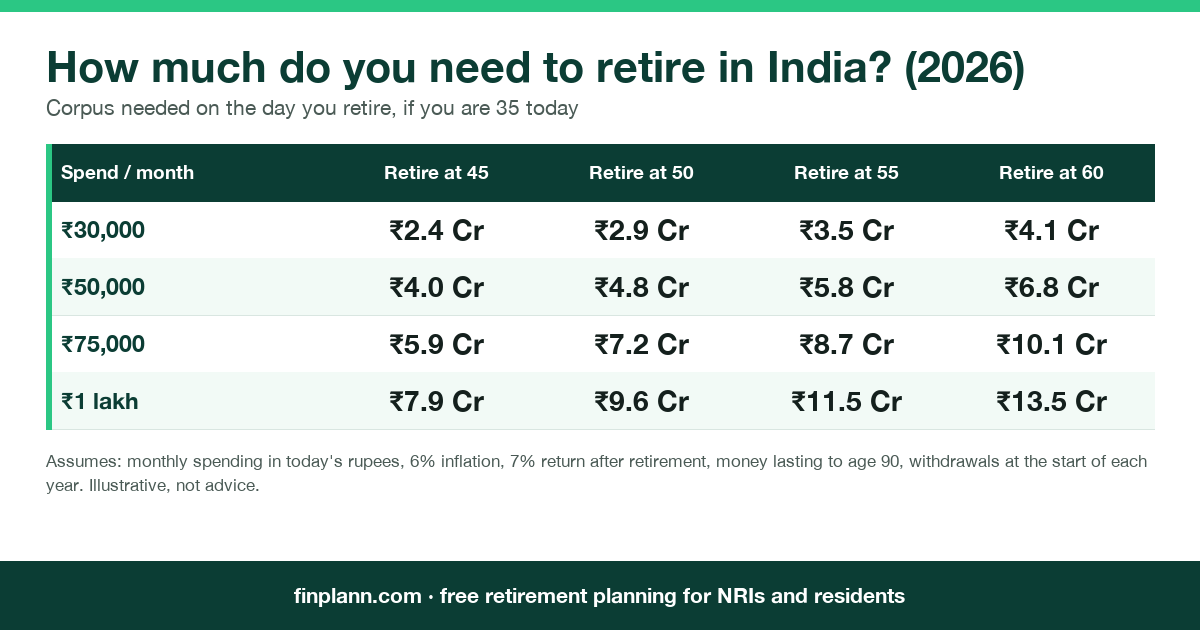
The corpus you need on the day you retire, if you are 35 today, by monthly spending in today's rupees. It uses the same assumptions as the tables above: 6% inflation, a 7% return after retirement and money lasting to age 90. Illustrative, not advice.
Share this table: you are welcome to use it on your site with a credit link. Copy this code:
<a href="https://finplann.com/blog/how-much-money-to-retire-india/"><img src="https://finplann.com/static/img/infographics/retirement-corpus-india-2026.png" alt="How much do you need to retire in India in 2026: corpus needed by monthly spend and retirement age, FinPlann" width="1200" height="630"></a>
<p>Source: <a href="https://finplann.com/blog/how-much-money-to-retire-india/">FinPlann</a></p>
Writing about retirement? You can add a free, compact version of our retirement calculator to your own site. The embed code is on the calculator page.